
Is AI Bookkeeping Safe and Accurate? How to Check
By Soniya Ali, Book Keeping Department Head at eLeopards Technologies · 16 Nov 2026 · 5 min read
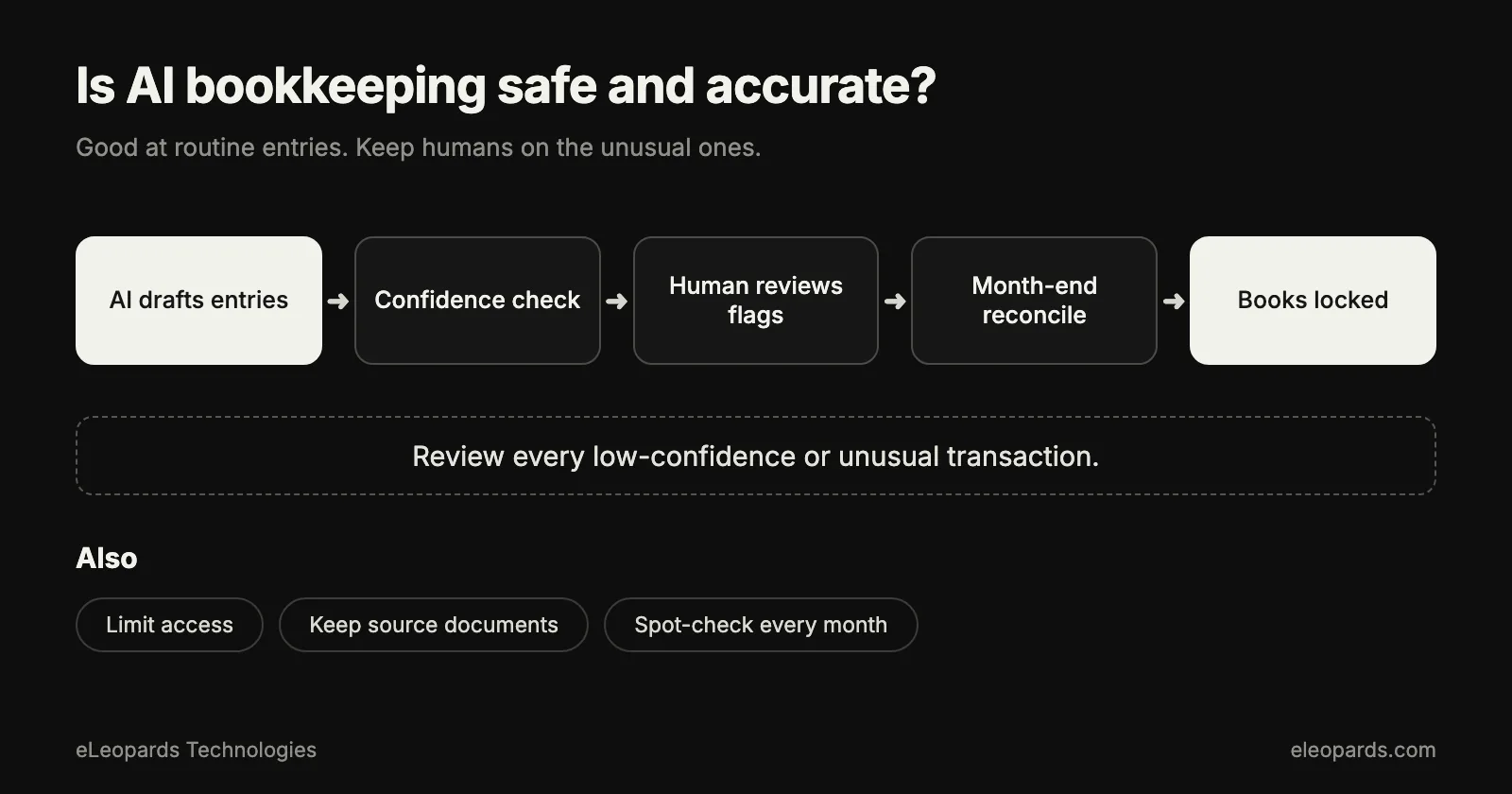
Quick answer
AI can speed up bookkeeping, but accuracy and safety depend on setup. Learn what to verify, how to protect your data and where human review belongs.
AI bookkeeping can be accurate and safe when you set it up with review steps and sensible data protection. It handles repetitive work well and is strongest on clear, repeat transactions. Judgement-heavy items, such as unusual transactions and tax treatment, belong with a person. Verify results regularly and keep the original documents.
How accurate is AI bookkeeping?
Accuracy depends on your data quality, how consistent your transactions are and how well the tool has learned your rules. Repeat items such as rent, subscriptions and regular suppliers are usually categorised well. New vendors, split payments and one-off purchases need more checking. The reliable way to measure accuracy is to test the tool on your own transactions.
How do you measure accuracy yourself?
- Pick a past month that your bookkeeper has already finalised.
- Run the same transactions through the tool.
- Compare category by category and count the differences.
- Note which types of transaction cause most differences.
- Repeat after a month of corrections to see whether it improves.
What are the main risks?
- Confident errors: a wrong category presented as a certain answer.
- Duplicates: the same expense entered twice from a feed and a receipt.
- Data exposure: sensitive financial details shared with a provider whose terms you have yet to read.
- Drift: rules that worked last year and quietly stopped fitting.
- Over-trust: accepting suggestions in bulk without a look.
What are the safeguards that matter?
- Human approval before anything is posted, paid or filed.
- Monthly reconciliation to the bank statement, with the totals matching exactly.
- A visible history of every change and who made it.
- Access limited to the people and tools that need it, with two-step sign-in.
- Original invoices and receipts attached to each entry.
- Clear data terms from the provider, including export and deletion.
Where should a person always review?
Tax treatment, payroll, loans, owner contributions, asset purchases and anything filed with an authority. Treat AI output as a prepared draft and the reviewer as the person who signs it off.
A balanced way to use it
Let the software do the sorting, matching and reminders, and keep a bookkeeper or accountant for review and advice. This combination gives you the speed of automation and the confidence of a second pair of eyes. Our team works this way, pairing careful tools with experienced review.
Common questions
- Is AI bookkeeping accurate?
- It is strong on repeat transactions and weaker on new vendors, split payments and one-off items. Test it on your own past month and keep a person reviewing the results.
- How do I keep AI bookkeeping safe?
- Require approval before posting or paying, reconcile monthly to the bank statement, limit access with two-step sign-in, attach original documents, and read the provider's data terms.
Sources and further reading
- IRS: recordkeeping for small businesses — What records to keep and for how long
- U.S. Small Business Administration: manage your finances — Budgeting, accounting and cash flow basics
Want help with this?
Tell us what you are working on and we will reply within one business day.