
AI Cash Flow Forecasting for Small Business: Where to Start
By Soniya Ali, Book Keeping Department Head at eLeopards Technologies · 16 Nov 2026 · 6 min read
Quick answer
Learn how AI cash flow forecasting works, what data it needs, a simple 13-week method you can build first, and how to check whether a forecast is trustworthy.
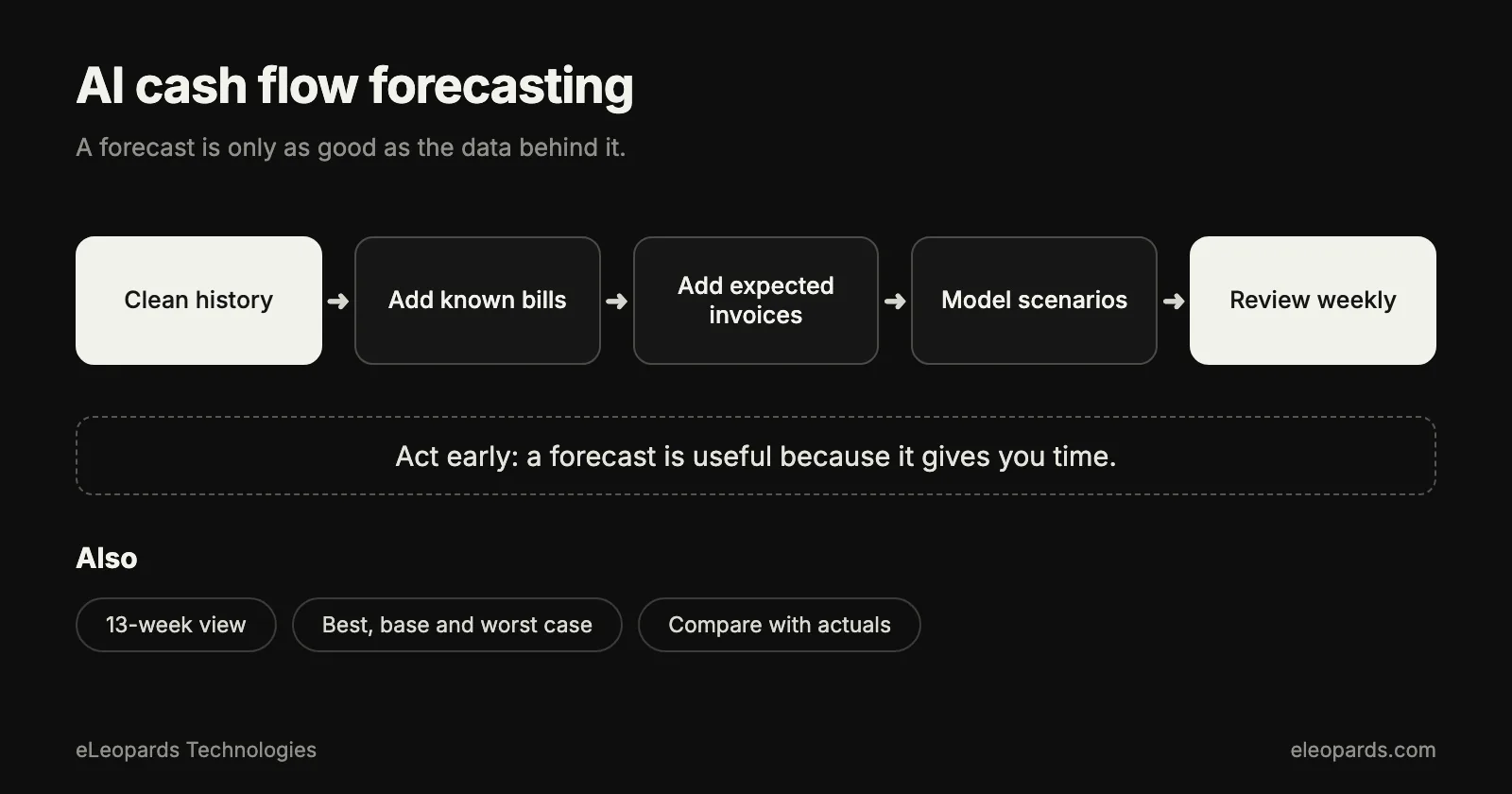
AI cash flow forecasting uses your past income and spending, plus known upcoming bills and invoices, to predict how much cash you will have in the coming weeks. It helps most when your books are up to date. A simple 13-week forecast built by hand is a strong first step, and AI tools then refine it.
What is cash flow forecasting?
A cash flow forecast lists the money you expect to receive and pay out over a period, and the balance you will have at the end of each week or month. Profit tells you whether the business earns money. Cash flow tells you whether you can pay the next bill on time.
How does AI improve a forecast?
- It learns patterns in your history, such as customers who always pay late or seasonal slow months.
- It combines open invoices, bills and recurring payments into one forward view.
- It reruns the forecast whenever new transactions arrive, so the picture stays current.
- It can show a range of outcomes, for example a cautious and an optimistic case.
- It flags weeks where the balance may dip below a level you choose.
What data does a forecast need?
- Up-to-date, reconciled bank transactions for at least the past year if possible.
- Open customer invoices with due dates and each customer's usual payment delay.
- Upcoming bills, loan repayments, payroll and tax payments.
- Planned one-off items, such as equipment or a seasonal stock purchase.
- Your starting bank balance.
How do you build a simple 13-week forecast first?
Thirteen weeks is long enough to see problems coming and short enough to stay accurate. Create one column per week and fill the rows in this order.
- Opening cash for the week.
- Expected receipts, based on invoice due dates adjusted for how late each customer usually pays.
- Expected payments: payroll, rent, suppliers, subscriptions, loan repayments and taxes.
- Net movement: receipts minus payments.
- Closing cash, which becomes next week's opening cash.
How do you know a forecast is trustworthy?
Compare each week's forecast with what actually happened and note the gap. If the gaps are small and random, the method works. If they are large and in the same direction, such as customers always paying later than predicted, adjust the assumption behind it.
Treat the forecast as a decision tool. A tool that warns you three weeks ahead of a low balance is valuable even when the exact figures move a little.
What actions does a forecast support?
- Sending invoice reminders earlier when a low week is coming.
- Negotiating payment terms with a supplier before cash is tight.
- Timing a large purchase for a stronger week.
- Arranging a short credit line ahead of time, instead of in a hurry.
- Deciding when hiring or marketing spend is affordable.
Choosing a tool
Check what your accounting software already includes before you buy anything new. Look for live bank feeds, a view of open invoices and bills, scenario comparisons and clear explanations of how each prediction is made. Run it alongside your hand-built forecast for a month or two and keep the one you trust.
Common questions
- What is AI cash flow forecasting?
- It predicts your future cash balance from past income and spending plus known invoices and bills, and updates the prediction as new transactions arrive.
- How far ahead should a small business forecast?
- Thirteen weeks is a practical start: long enough to spot a tight week early and short enough to stay accurate.
Sources and further reading
- IRS: recordkeeping for small businesses — What records to keep and for how long
- U.S. Small Business Administration: manage your finances — Budgeting, accounting and cash flow basics
Want help with this?
Tell us what you are working on and we will reply within one business day.