
PWA vs Native App vs Website: Which Fits Your Business
By Aqib Jon, Web Developer at eLeopards Technologies · 16 Nov 2026 · 6 min read
Quick answer
Compare a progressive web app, a native mobile app and a responsive website by cost, features, reach and upkeep, then use a simple checklist to choose the right one.
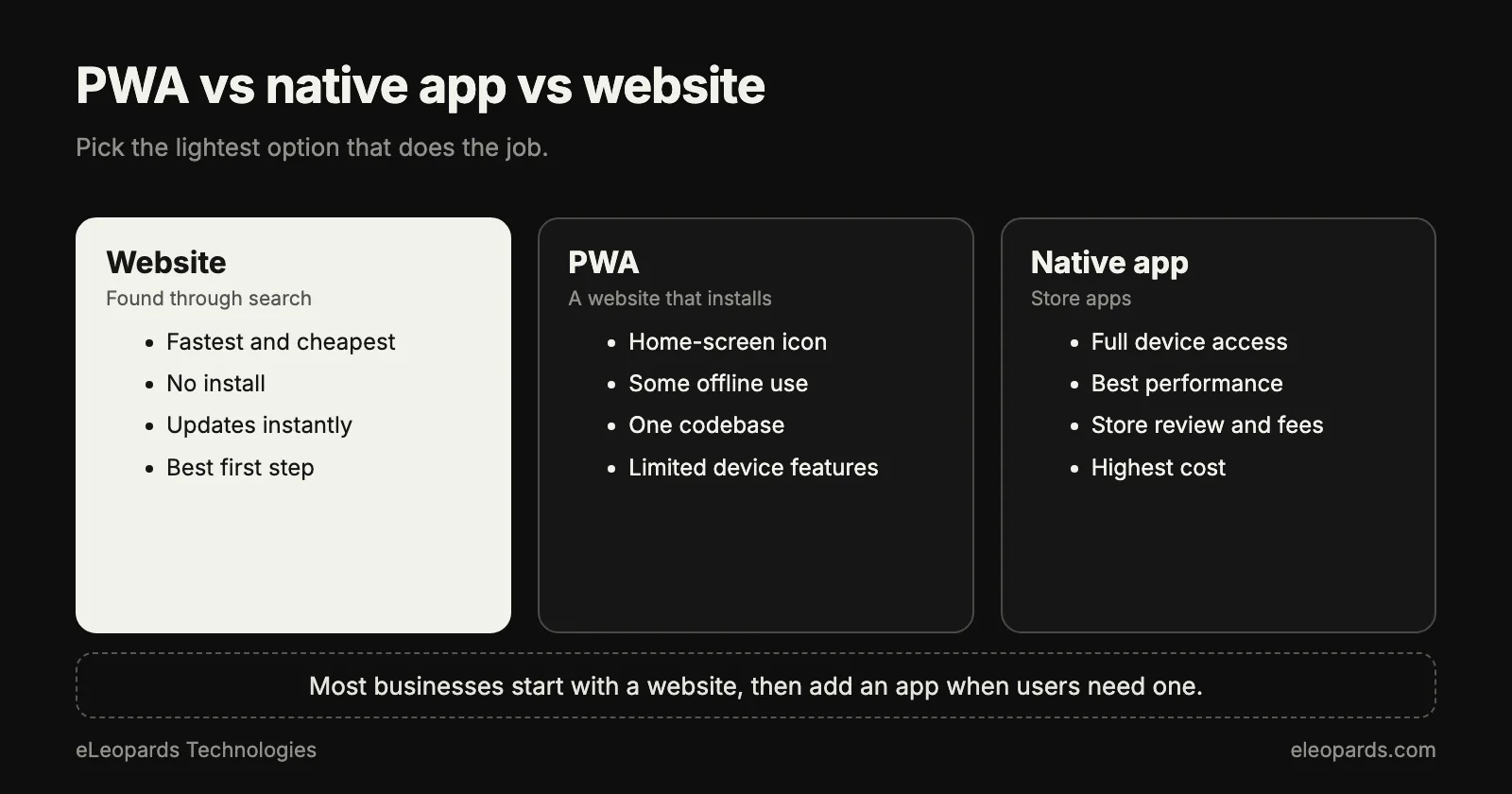
A responsive website suits most businesses that need to be found and to take enquiries. A progressive web app (PWA) adds app-like features such as installing to the home screen and some offline use. A native app is worth the extra cost when you need deep phone features or a daily-use experience. Match the choice to what your customers actually do.
What is the difference between each option?
- Responsive website: one site that adapts to any screen, found through search and shared by link.
- Progressive web app: a website built with extra abilities, so people can install it, receive some notifications and use parts of it offline.
- Native app: software built for iPhone or Android and distributed through the app stores, with full access to the phone's features.
How do they compare on cost and effort?
A website is the lowest cost and the quickest to launch. A PWA builds on the same codebase, so it costs a little more than a website and usually much less than two native apps. Native apps need separate work for each platform, store review, and regular updates to keep pace with new phone versions.
How do customers find each one?
Websites and PWAs are discoverable through search engines, which is a major advantage for acquiring new customers. Native apps are discovered mainly through app store search, ads and word of mouth, and people need to download them first. If search is how you win customers, the web has a built-in edge.
Which features need a native app?
- Advanced camera, sensors, Bluetooth or background location.
- Heavy graphics or smooth animation, as in games.
- Deep links into other phone features and widgets.
- A product people open many times a day, where being on the home screen is central.
- Features that rely on the latest phone capabilities as soon as they launch.
When does a PWA make sense?
- You want an app-like experience without the app stores.
- Your users are on mixed devices and you want one codebase.
- Content should load quickly and keep working on a weak connection.
- You have a content, booking, ordering or dashboard product that runs on standard web features.
- You want to test demand before investing in native apps.
A quick checklist to decide
- Do customers find you through search? Start with a website or PWA.
- Do you need the camera, sensors or background features? Consider native.
- Is your budget limited? Launch the website or PWA first and learn from real use.
- Will people use it daily? A native app may earn its cost.
- Is your audience mostly on one platform? A single native app can be enough.
A common path
Many businesses begin with a fast, well-structured website, add PWA features such as installation and offline pages once they see repeat use, and build native apps when a clear feature or usage pattern justifies them. Each step builds on the one before, so the earlier work is never wasted. Our guide on whether to build a website or a mobile app first walks through the same decision from the start.
Common questions
- What is the difference between a PWA and a native app?
- A PWA is a website with app-like abilities such as installing and some offline use. A native app is built for iPhone or Android and can use the phone's full feature set.
- Should I build a PWA or a native app first?
- If customers find you through search or your product needs standard web features, start with a website or PWA. Choose native when you need deep phone features or daily-use engagement.
Sources and further reading
- Apple: App Store Review Guidelines — What an iOS app must meet to be approved
- MDN: Progressive web apps — The web alternative to a native app
Want help with this?
Tell us what you are working on and we will reply within one business day.