
GEO and AEO: How to Get Your Business Cited by AI Search
By Ahad Karim, Content Manager at eLeopards Technologies · 15 Sept 2026 · 6 min read
Quick answer
What Generative and Answer Engine Optimization mean, and practical steps to appear in AI answers.
People increasingly ask ChatGPT, Gemini, Perplexity and Google AI Overviews instead of scrolling through links. GEO and AEO are the practices of making your content easy for those systems to find, understand and cite.
What the terms mean
- AEO (Answer Engine Optimization): structuring content so it can be lifted as a direct answer.
- GEO (Generative Engine Optimization): making your brand and pages likely to be summarised and cited by AI engines.
- Both build on solid SEO. They do not replace it.
What helps
- Answer the question in the first sentence, then explain.
- Add FAQ sections with short, direct answers to real customer questions.
- Use schema markup (Organization, FAQPage, Service, Article) so the structure is explicit.
- Keep facts consistent everywhere: name, services, contact details and location.
- Publish original, specific information. Generic content gives AI nothing worth citing.
Let AI crawlers in
Check your robots.txt does not block AI crawlers you want to reach you. You can also publish an llms.txt file, a plain summary of your site for language models. It is an emerging convention, so treat it as a small bonus rather than a guarantee.
Make content render without scripts
Important text and numbers should appear in the server-rendered HTML. If a stat only appears after a script runs, many crawlers will never see it.
How AI search differs from classic search
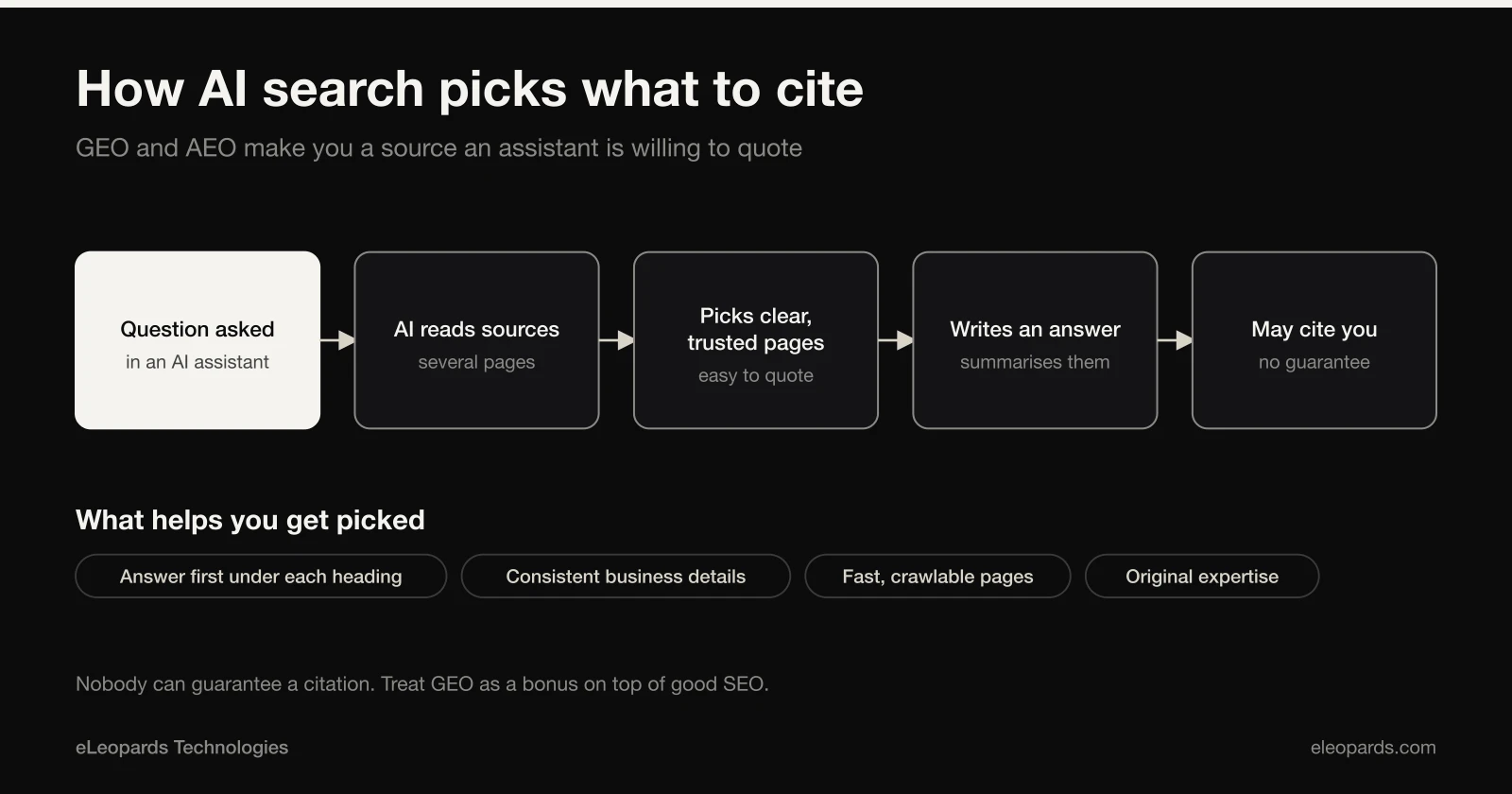
A traditional search engine returns a list of links and lets you choose. An AI answer engine reads several sources, writes a summary and sometimes cites where it came from. That means your goal shifts from only ranking a page to being a clear, trustworthy source the system is willing to quote.
Write passages that can be quoted
- Answer the question directly in the first sentence or two under a heading.
- Use plain, specific wording instead of vague claims.
- Keep one idea per paragraph so a passage makes sense on its own.
- State facts that can be checked: names, locations, services, prices where possible.
Show who you are
AI systems favour sources they can tie to a real organisation. Make your name, location, services and contact details consistent across your website, your Google Business Profile and your social profiles. An About page, named authors and a clear description of what you do all help a system understand and trust you.
What not to expect
Nobody can guarantee a citation from any AI product, and the systems change often. Treat this work as a bonus on top of good SEO, not a replacement for it. The habits are the same ones that help human readers anyway: clear structure, honest answers and pages that load fast.
Be realistic
No one can guarantee a citation. The reliable approach is the same as good SEO: be genuinely useful, clear and trustworthy, and make that easy for machines to read.
Common questions
- What is GEO?
- Generative engine optimization (GEO) is making your content easy for AI tools to understand, quote and cite when they answer questions.
- What is the difference between GEO and AEO?
- Answer engine optimization (AEO) focuses on structuring pages so a search feature or assistant can pull a direct answer. GEO covers the wider effort to be a trusted source in AI-generated answers. The habits overlap.
Want help with this?
Tell us what you are working on and we will reply within one business day.
Start a Project