
How to Write a Website Brief That Gets You an Accurate Quote
By Aqib Jon, Web Developer at eLeopards Technologies · 13 Oct 2026 · 4 min read
Quick answer
What to include in a project brief so agencies understand your needs and price them correctly.
A clear brief saves time, prevents misunderstandings and gets you quotes you can compare. It does not need to be long, only specific.
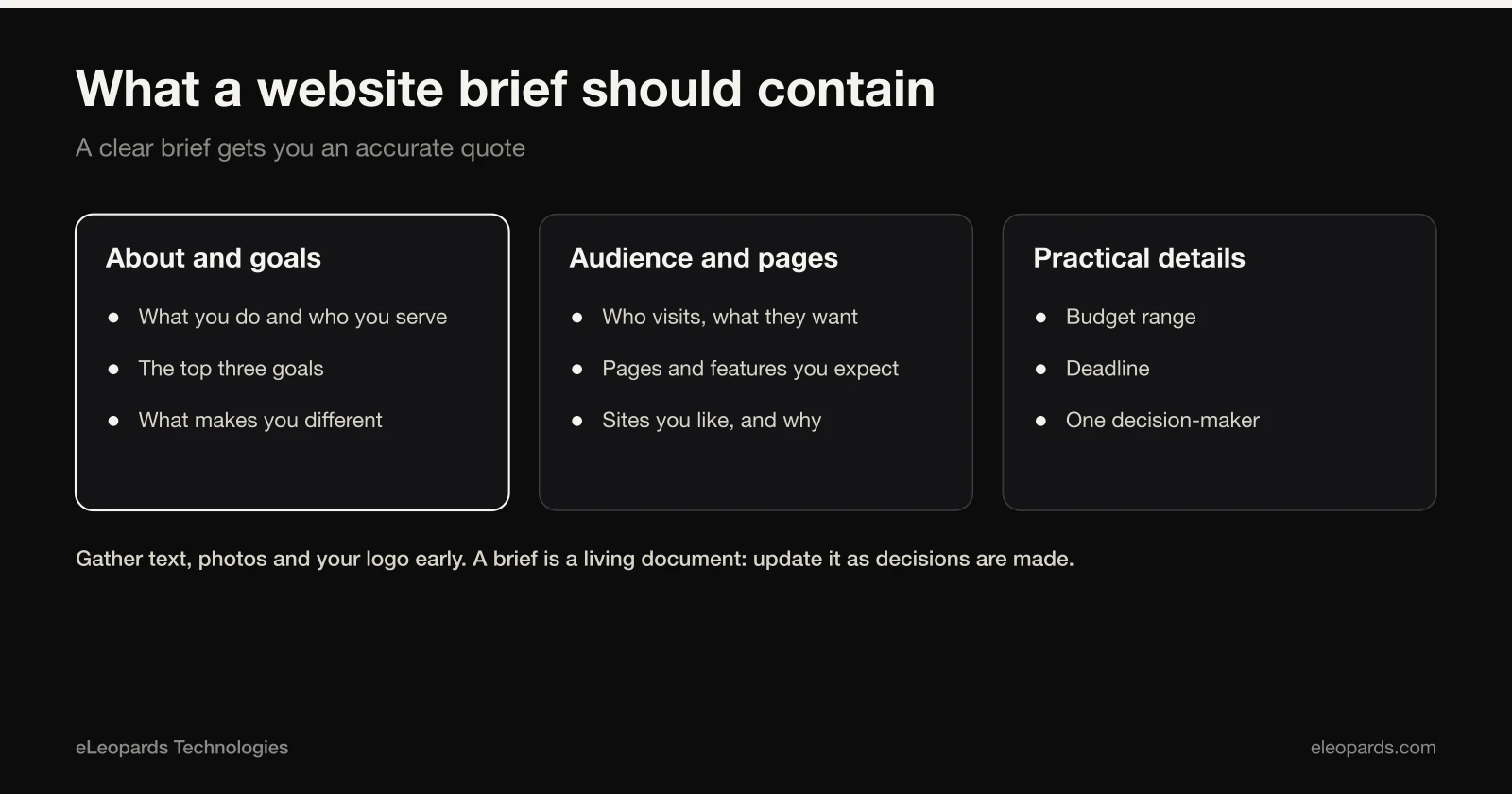
What to include
- About your business: what you do, who you serve and what makes you different.
- The goal: more enquiries, sales, bookings, trust or something else.
- Your audience: who visits the site and what they need.
- Pages and features you expect, such as booking, payments or a blog.
- Examples of sites you like and dislike, with reasons.
- Content status: is the copy, photography and video ready?
- Timeline and budget range.
Describe problems, not only solutions
Saying 'our current site loses enquiries because the contact form is hard to find' gives an agency more to work with than 'we want a new design'.
Be honest about budget
Sharing a range helps the agency recommend a realistic scope instead of guessing. A good agency will tell you what is achievable within it.
A simple structure you can copy
- About us: what you do, who you serve and what makes you different.
- Goals: the three most important things the site must achieve.
- Audience: who visits and what they want to do.
- Pages and features: what you think you need.
- Examples: sites you like and why.
- Practical details: budget range, deadline and who decides.
Common gaps that cause delays
Projects slow down when content is not ready, when several people give conflicting feedback, or when the goal was never clearly agreed. Name one decision-maker on your side, gather your text, photos and logo early, and agree how feedback will be collected so the team is not waiting.
Share what already works
Tell the agency what is working on your current site and what is not. Include any analytics, customer feedback or common questions your team receives. This real information helps the agency design around actual behaviour rather than assumptions.
Keep the brief a living document
A brief is a starting point, not a contract. Expect it to be refined in the first conversations. Update it as decisions are made so that everyone works from the same version, and keep a short record of what was agreed and why.
Ask for a written scope
Request a quote that lists deliverables, timeline and what is not included. It makes comparing proposals straightforward.
Want help with this?
Tell us what you are working on and we will reply within one business day.
Start a Project