
Bookkeeping Basics Every Small Business Owner Should Know
By Soniya Ali, Bookkeeping Team Member at eLeopards Technologies · 22 Sept 2026 · 5 min read
Quick answer
The core ideas behind bookkeeping, explained without jargon, so your numbers make sense.
Bookkeeping is the habit of recording every financial transaction accurately and on time. Good books answer simple questions: are we profitable, who owes us money, and can we afford the next step?
What bookkeeping covers
- Recording income and expenses.
- Categorising each transaction so reports are meaningful.
- Tracking invoices you have sent and bills you owe.
- Reconciling your records against bank statements.
Bookkeeping versus accounting
Bookkeeping keeps the records. Accounting interprets them: preparing statements, planning tax and advising on decisions. Clean books make accounting faster and cheaper.
The reports that matter
- Profit and loss: income minus expenses over a period.
- Balance sheet: what you own and owe at a point in time.
- Cash-flow statement: money actually moving in and out.
Common mistakes
- Mixing personal and business spending.
- Letting receipts pile up until year end.
- Skipping bank reconciliation.
- Not keeping supporting documents.
A look at the daily habits
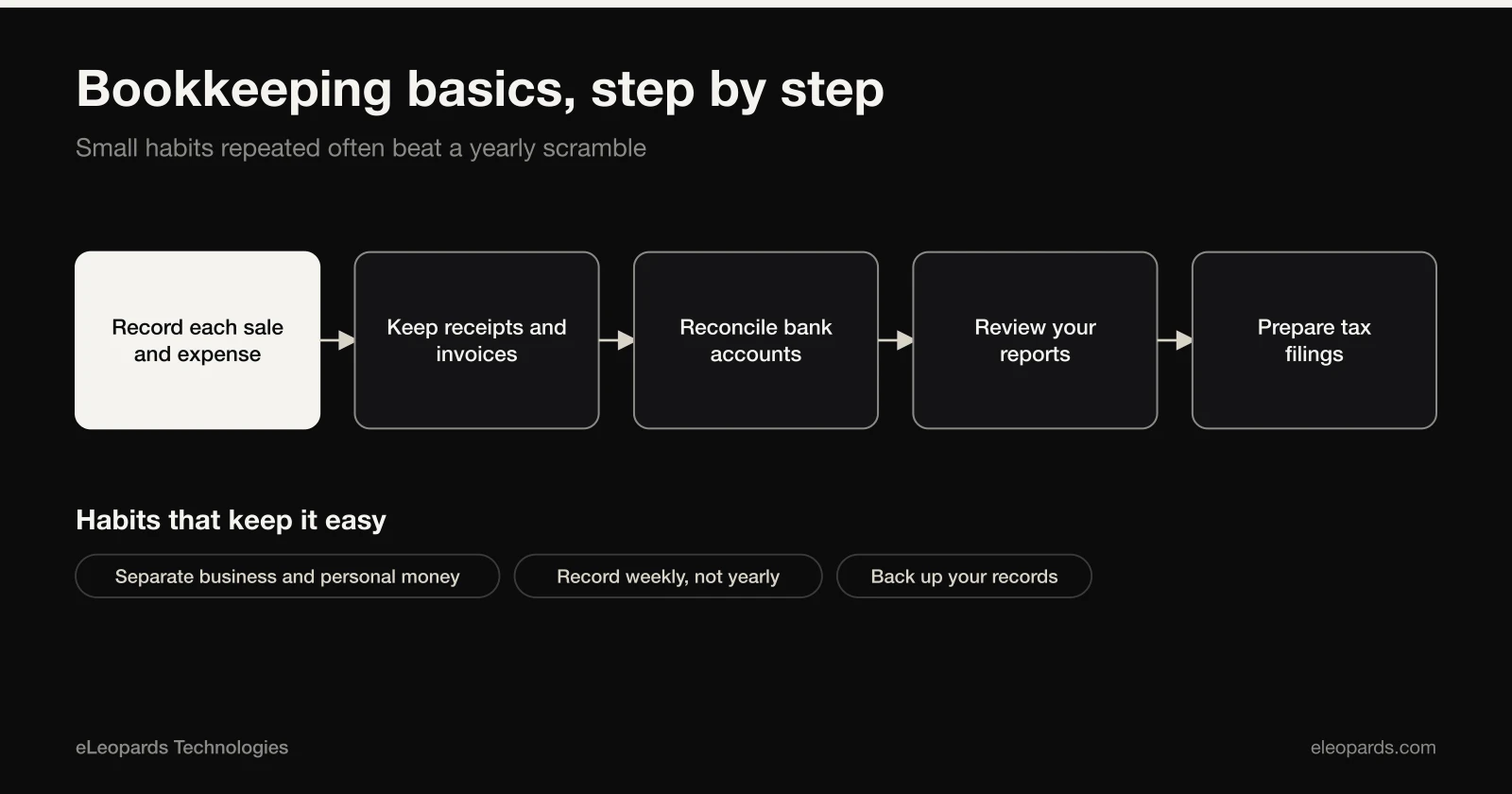
Good bookkeeping is mostly small habits repeated often. Record each sale and expense soon after it happens, keep the receipt or invoice, and note what the money was for. Doing this weekly takes minutes. Leaving it for months means guessing, and guesses lead to errors at tax time.
Keep business and personal money apart
Use a separate bank account and payment card for the business. When personal and business spending mix, every transaction has to be sorted by hand, and it becomes much harder to see how the business is really doing. A clean separation also makes it easier to prove your numbers if anyone asks.
Records worth keeping
- Sales invoices and proof of payment received.
- Supplier bills and receipts for expenses.
- Bank and card statements for every account.
- Payroll records, if you employ people.
- Tax filings and correspondence with tax authorities.
When to ask for help
If bookkeeping is taking time away from the work you are good at, or if you are behind and unsure where things stand, a bookkeeper can catch you up and set up a routine that is easy to keep. The right time is before the problem grows, not after a deadline has passed.
A simple starting point
Open a separate business bank account, pick accounting software, and set aside a fixed time each week to record and categorise transactions.
Want help with this?
Tell us what you are working on and we will reply within one business day.
Start a Project