
Spec-Driven Development: How to Get Better Results From AI Coding Agents
By Aqib Jon, Web Developer at eLeopards Technologies · 6 Nov 2026 · 6 min read
Quick answer
Writing a clear specification before letting an AI agent code is the trend of the year. Here is how it works and how to try it.
Spec-driven development means writing down what you want built, and how you will know it works, before an AI coding agent writes any code. The agent then follows that specification instead of guessing. It is a reaction to a common experience: vague prompts produce code that looks right but misses the point. GitHub's open-source spec-kit toolkit, reported among trending repositories in November 2026, is one example of tooling built around the idea.
Why vague prompts fail
Asking an agent to build a booking page leaves hundreds of decisions unstated: who can cancel, what happens when a slot is taken, which emails are sent. The agent fills the gaps with assumptions, and you discover them late. A specification moves those decisions to the start, when they are cheap to change.
What goes in a useful spec
- The goal in one or two sentences, and who it is for.
- The user journeys, written as simple steps.
- Rules and edge cases: limits, errors, permissions.
- What is out of scope, so the agent does not invent extra features.
- Acceptance checks: how a person will confirm each requirement works.
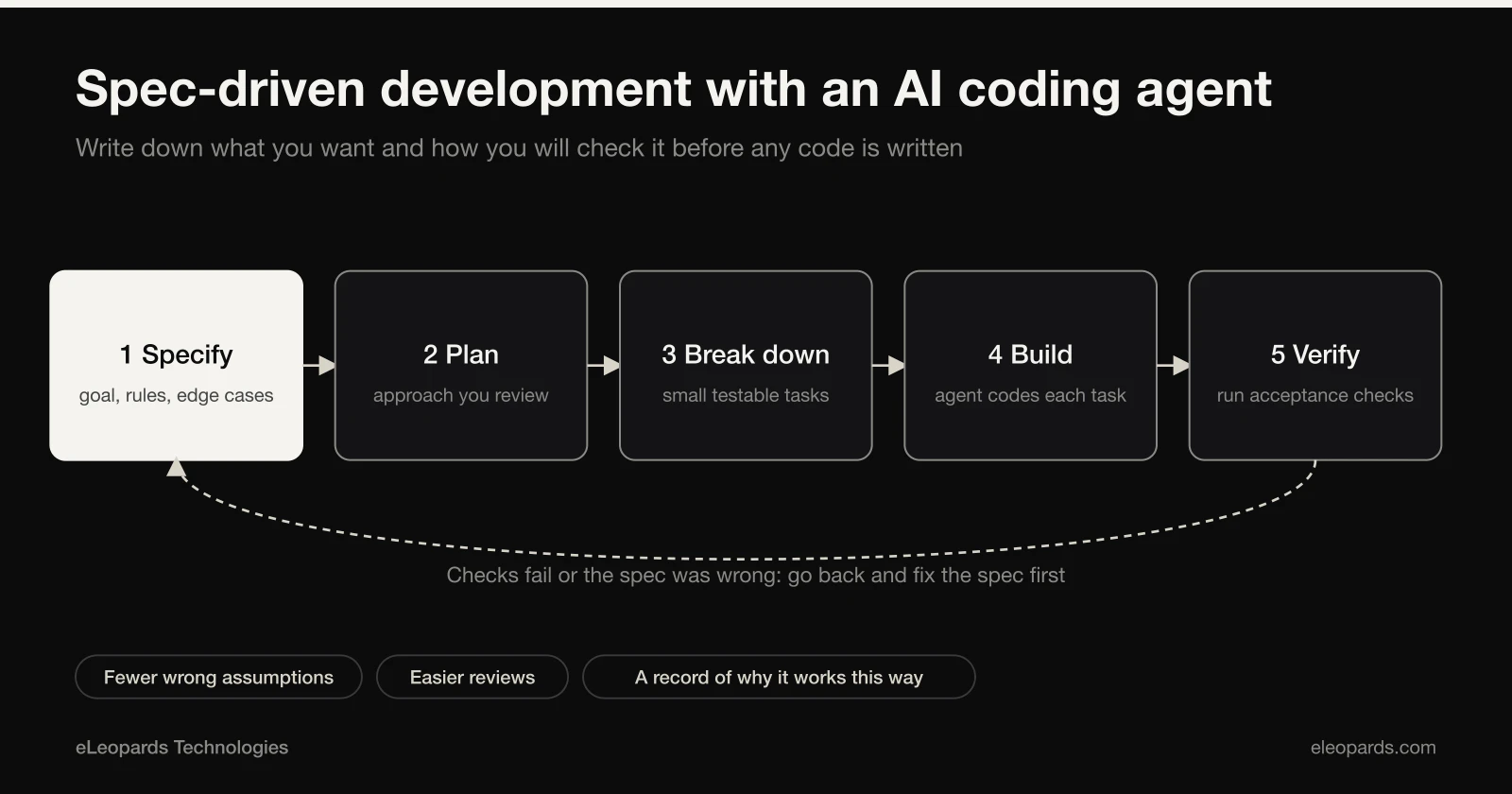
The workflow in four steps
- Specify: write the requirements and review them with the people who care.
- Plan: ask the agent for a technical plan and check it against your constraints.
- Break down: split the plan into small tasks that can each be tested.
- Build and verify: let the agent implement task by task, running the acceptance checks each time.
Benefits and honest limits
A good spec reduces rework, makes reviews easier and leaves a record of why the software behaves as it does. It does not remove the need for human judgement. A specification can still be wrong, and the agent can still misread it, so testing and review remain essential. The extra writing is worth it for features with real business rules and less so for a throwaway prototype.
How we use it with clients
Our own projects already start with a written brief and agreed pages, flows and success measures. Spec-driven habits extend that clarity to the code stage. If you are commissioning software, ask your developer how requirements are written down and how each one is checked before launch.
Want help with this?
Tell us what you are working on and we will reply within one business day.
Start a Project